
'Investors need to expect steady returns over the next one to two years with bouts of high volatility.'

A mistake here can prove costly.

Total assets under management (AUM) for September stood at Rs 20.4 lakh crore compared with Rs 20.6 lakh crore at the end of August.

So far in 2017, the Nifty has gone up by 22.4 per cent.

Ahead of Friday's extraordinary general meeting (EGM), Byju Raveendran, chief executive officer (CEO) of Byju's, told shareholders that he is committed to restructuring the board of the embattled educational technology (edtech) firm. He also committed to appointing two non-executive directors to the board by the mutual consent of the founder and shareholders. The development comes at a time when a consortium of key shareholders, holding over 30 per cent stake in Byju's, issued a notice to the embattled edtech firm this month, calling for an EGM to address "persistent issues", including a proposed change of management at the firm.
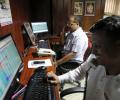
For the first time in a decade, the BSE Midcap and Smallcap indices outperformed the benchmark index for a consecutive year

Amit Shah's net worth grew 32 per cent to Rs 37.91 crore, mainly due to 80 per cent appreciation in the market value of his securities.

Lump sum investments in equity and hybrid schemes of mutual funds (MFs) declined to Rs 17,900 crore in October - the lowest since January 2021. The fall in lump sum investments comes even as flows through systematic investment plans (SIPs) rose to a new all-time high of Rs 13,000 crore in October. The latest lump sum tally is just a third of the peak inflow of Rs 49,700 crore in July 2021.

Rising oil prices, sharp slowdown in mutual fund inflows and steep valuations remain the key risks for Indian investors going ahead.

Sanjay Kumar Singh suggests key factors investors need to keep an eye on while choosing the direct investment route.

SBI was the top gainer in the Sensex pack, spurting over 2 per cent, followed by TCS, Tech Mahindra, HUL, Bajaj Finance, Kotak Bank and Titan. On the other hand, IndusInd Bank, PowerGrid, Bharti Airtel, Asian Paints and HDFC Bank were among the laggards.
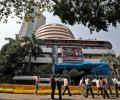
India remains one of the most over-owned market in Asia.

Buoyed by the success of secondary market, IPO market set to see high action

'Stick to FDs of shorter tenures, preferably one-two years.'

Bajaj Finance was the top laggard in the Sensex pack, dropping over 9 per cent, followed by Axis Bank, IndusInd Bank, HDFC, ICICI Bank and M&M. Reliance Industries, however, capped the losses by rallying over 3 per cent. Sun Pharma, Hero MotoCorp, L&T, PowerGrid and Bajaj Auto were also among the gainers.

'A fund investor could pick, say, three of the top active funds in any given category.'

To curb mis-selling of policies and rationalise commissions, radical changes have been proposed to help investors.

Smaller stocks have continued to give higher returns to equity investors so far this fiscal, significantly outperforming bigger peers on indices. The BSE smallcap index has zoomed 7,333.47 points or 35.51 per cent, while midcap index has jumped 5,096.41 points or 25.25 per cent so far this fiscal. In comparison, the 30-share BSE benchmark Sensex has gained 9,797.78 points or 19.78 per cent.

Three key instruments that can help you meet your financial goals, while also allowing you to enjoy tax deductions are ELSS, term cover and health cover.

Most equity schemes have more than doubled their NAVs in 8 years, even if they entered at the pre-Lehman crisis peak
Investors should look at actively managed funds, says Devangshu Datta.

With home loan rates headed north, experts advise how borrowers should cope with their rising liabilities.

Senior citizens should avoid putting their entire retirement corpus in SCSS.

When looking for alternatives, consider several parameters -- your investment horizon and liquidity requirement, post-tax returns, and risk.

Smaller stocks continue to shine at the bourses. The BSE MidCap index is up 18 per cent since the beginning of January this year against a 5 per cent rise in the Sensex during the period. With the current rally, the mid-cap index has doubled in value since the end of March 2020 against a 70 per cent rally in the Sensex during the period. On Tuesday, the mid-cap index closed at 21,232, as compared to 17,941 at the end of December 2020. In the same period, the benchmark index moved from 47,751 to 50,193.

The government on Friday proposed hiking the securities transaction tax on Futures & Options (F&O) contracts, a move that will increase the trading costs in the derivatives segment as well as help in curbing excessive trades. In the Finance Bill 2023, passed by the Lok Sabha on Friday, the Securities Transaction Tax (STT) on options is proposed to be increased to 0.0625 per cent from 0.05 per cent and on futures contracts to 0.0125 from 0.01 per cent. Analysts opined that higher STT will shore up the government's revenues to some extent and also discourage excessive trading since a large number of retail traders are losing money in the segment.

'Younger investors start their journey with very little capital so they are risking less while they have a lot of time to experiment and learn early on.'

'As the growth momentum reverses benefiting from re-monetisation, it will be accompanied by a rise in inflation.'

In April, the inflows into equity schemes dropped 60% compared to the previous month to Rs 4,608 crore, the lowest since Sept 2016.
Should you expect 15 per cent return over a period of 20 years? Dwaipayan Bose has the answer

Staggered pull-out will help investors if the market continues to rise.
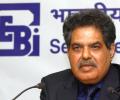
In his first two years, Tyagi, a Himachal Pradesh cadre IAS officer, has implemented challenging stock market reforms and taken action against high-profile corporate entities.

It is best not to get carried away by returns or take a short-term view of the markets, says Bhavana Acharya.

Indian markets rose 19 per cent in the first half of this financial year, the best performance by any market during this period, globally.

If you are buying a bond to cater to your regular income needs, check the interest distribution schedule.

The benchmark Nifty rallied 1,000 points or 17% from 7,000 in 78 trading sessions since May 12, till date to surpass the 8,000 mark.

Two factors play a predominant role in fetching good returns -- stock selection and allocation, suggests Sanjay Kumar Singh.
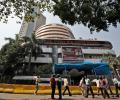
Sentiments turned somewhat weak towards the middle of the session as profit-booking emerged as investors turned cautious on disappointing quarterly earnings by some bluechip companies

'Largely, new demat accounts are now being opened by the younger crowd, particularly GenZ.' 'This is great news since younger investors start their journey with very little capital, so they are risking less.'

'Any normalisation exercise will bring its share of volatility.'
 © 2026 Rediff.com - Advertise with us - Disclaimer - Privacy Policy - Sitemap - Feedback - About us - Terms of use - Grievances